book of greek myths d’aulaires pdf
D’Aulaires’ Book of Greek Myths PDF: A Comprehensive Guide (Updated 02/11/2026)
Today’s date is 02/11/2026! This guide explores accessing the D’Aulaires’ Book of Greek Myths in PDF format, covering download options and related resources.
Numerous sources offer the 1962/1992 edition as a free PDF download, alongside discussions of Norse mythology and related books.
Software-generated samples and archived versions are available, with file sizes around 1031 kb, offering access to classic Greek gods and stories.
Explore the enchanting world of ancient tales, readily available for digital reading and study, enhancing your understanding of mythology and narrative.
What is D’Aulaires’ Book of Greek Myths?
D’Aulaires’ Book of Greek Myths, originally published in 1962, is a beloved and highly acclaimed retelling of classic Greek mythology for young readers. This enduring work, penned by Ingri and Edgar Parin d’Aulaire, presents the intricate tales of gods, heroes, and monsters in a captivating and accessible manner.
The book isn’t merely a collection of stories; it’s a beautifully illustrated journey into the heart of ancient Greece. It covers foundational myths, including the origins of the gods, the adventures of Hercules and Perseus, and encounters with legendary creatures like the Cyclops and the Minotaur.
Today, the book continues to be popular, readily available as a PDF download, allowing new generations to discover these timeless narratives. Its enduring appeal lies in its ability to simplify complex myths without sacrificing their essence, making it an ideal introduction to Greek mythology for children and adults alike.
Historical Context and Publication History
D’Aulaires’ Book of Greek Myths first emerged in 1962, a period marked by renewed interest in classical literature and mythology within American education and culture. The book’s publication coincided with a desire to introduce children to these foundational stories in an engaging format.
The original edition was a significant undertaking, showcasing the authors’ dedication to both storytelling and artistic presentation. A revised edition appeared in 1992, updating the text and illustrations while maintaining the core spirit of the original work.
The book’s longevity is evident in its continued availability, including widespread PDF versions circulating online today. These digital copies ensure the stories remain accessible, preserving its legacy for future readers and scholars interested in the history of children’s literature and mythological retellings.
The Authors: Ingri and Edgar Parin d’Aulaire
Ingri and Edgar Parin d’Aulaire were a husband-and-wife team celebrated for their contributions to children’s literature. Immigrating to the United States from Sweden, they brought a unique artistic sensibility and storytelling approach to their work. Their collaborative process blended Ingri’s narrative skills with Edgar’s distinctive illustrations.
Prior to D’Aulaires’ Book of Greek Myths, they gained recognition for D’Aulaires’ Book of Norse Myths, establishing their talent for adapting complex mythological narratives for young audiences. Their commitment to creating visually appealing and accessible books resonated with readers and educators alike.
The enduring popularity of their work, including readily available PDF versions of their Greek Myths, demonstrates their lasting impact on children’s literature and the continued appreciation for their artistic vision.
Illustrations and Artistic Style
Edgar Parin d’Aulaire’s illustrations are a defining characteristic of D’Aulaires’ Book of Greek Myths. His style is instantly recognizable, featuring dynamic figures and a vibrant color palette that brings the ancient world to life. The artwork isn’t strictly realistic; instead, it possesses a charming, slightly stylized quality, perfectly suited for a younger audience.
The illustrations within the PDF versions of the book are integral to the storytelling, enhancing the narrative and making the characters and creatures memorable. They capture the essence of each myth with a blend of energy and grace, contributing significantly to the book’s enduring appeal.
These distinctive visuals, preserved in digital formats, continue to captivate readers, showcasing the d’Aulaires’ artistic talent and their ability to visually interpret classical mythology.
Finding and Downloading the PDF
Numerous online sources provide access to the D’Aulaires’ Book of Greek Myths PDF, including archives and free download options for this classic text.
Digital versions are readily available, offering convenient access to these timeless tales of Greek gods and legendary heroes.
Legitimate Sources for PDF Download
Securing a PDF copy of D’Aulaires’ Book of Greek Myths from reputable sources is crucial to avoid potential malware or copyright infringements. While free downloads exist, verifying the source’s legitimacy is paramount. Internet Archive (archive.org) frequently hosts digitized versions of older books, including this title, offering a safe and legal avenue for access.
Additionally, exploring university library digital collections or educational resource websites may yield legitimate PDF downloads. Some online bookstores also offer authorized digital copies for purchase. Be cautious of websites promising free downloads that appear suspicious or request personal information. Prioritize sources known for their commitment to copyright compliance and data security. Always scan downloaded files with updated antivirus software as a precautionary measure, ensuring a safe and enjoyable reading experience of these beloved myths.
Free vs. Paid PDF Versions
The availability of D’Aulaires’ Book of Greek Myths in PDF format presents a choice between free and paid options, each with distinct advantages and drawbacks. Free versions, often found on archive sites or through unofficial channels, offer cost-effective access but may lack the quality or completeness of paid editions.
Paid PDF versions, typically purchased from reputable online bookstores, guarantee a high-resolution, fully formatted copy, supporting the authors and publishers. These often include enhanced features like searchable text and bookmarking capabilities. While free downloads can be tempting, consider the ethical implications and potential risks associated with copyright infringement. Investing in a paid version ensures a superior reading experience and supports the continued creation of valuable literary works.
Potential Risks of Unofficial Downloads
Downloading D’Aulaires’ Book of Greek Myths from unofficial sources carries significant risks. These PDFs may contain malware, viruses, or other malicious software that can compromise your device and personal information. The quality of these files is often substandard, featuring missing pages, distorted images, or poor formatting, hindering the reading experience.
Furthermore, obtaining PDFs through unauthorized channels constitutes copyright infringement, which is illegal and unethical. Supporting these sources undermines the authors and publishers who invested time and resources in creating the book. Prioritize your digital security and respect intellectual property rights by opting for legitimate download sources. Always scan downloaded files with reputable antivirus software before opening them, and consider the potential consequences before resorting to unofficial downloads.
File Size and System Requirements
The PDF version of D’Aulaires’ Book of Greek Myths generally has a relatively small file size, typically around 1031 kilobytes (kb). This compact size ensures quick downloads and minimal storage space requirements on your devices. It’s compatible with a wide range of operating systems, including Windows, macOS, Android, and iOS.
To view the PDF, you’ll need a PDF reader application, such as Adobe Acrobat Reader, which is available as a free download. Most modern web browsers also have built-in PDF viewing capabilities. System requirements are minimal; even older computers and mobile devices can easily handle this file format. The book’s accessibility makes it convenient for readers of all technological backgrounds.

Key Myths and Characters Covered
D’Aulaires’ Book of Greek Myths vividly portrays Olympian gods like Zeus, Hera, and Poseidon, alongside heroic figures such as Hercules, Perseus, and Theseus.
Notable creatures—Cyclops, Minotaur, Centaurs—populate these tales, alongside captivating creation myths detailing the origins of the ancient Greek gods.
The Olympian Gods: Zeus, Hera, Poseidon
D’Aulaires’ Book of Greek Myths beautifully introduces the powerful Olympian deities, central figures in ancient Greek religion and mythology. Zeus, the king of the gods, is depicted with his commanding presence and control over the sky and thunder, showcasing his authority and often, his complex personality.
Hera, Zeus’s wife and queen of the gods, is portrayed as a majestic yet often jealous and vengeful figure, fiercely protective of marriage and family. The book details her struggles and interactions with mortals and other deities.
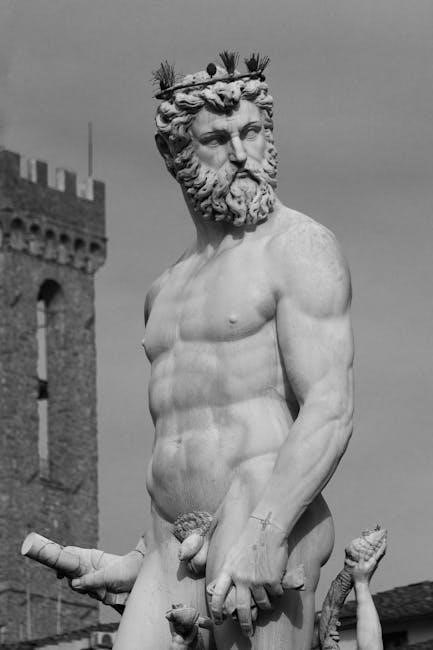
Poseidon, brother to Zeus and Hades, reigns over the seas, depicted with his trident and mastery over the ocean’s depths. The PDF version allows readers to explore these characters through the D’Aulaires’ distinctive illustrations and accessible storytelling, bringing these powerful gods to life for a younger audience.
These foundational deities form the core of many myths within the book, influencing the fates of heroes and mortals alike, and providing a rich tapestry of interconnected narratives.
Heroes and Heroines: Hercules, Perseus, Theseus
D’Aulaires’ Book of Greek Myths vividly recounts the extraordinary exploits of legendary heroes. Hercules, famed for his incredible strength and twelve labors, is presented as a complex figure battling monsters and overcoming immense challenges, detailed within the PDF’s pages.
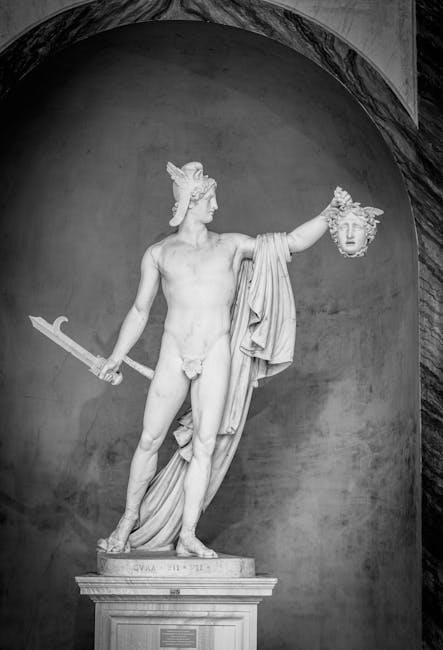
Perseus, the slayer of Medusa, embodies courage and resourcefulness, his quest to defeat the Gorgon brought to life through captivating illustrations and narrative. The book simplifies the myth for younger readers, maintaining the core elements of the story.
Theseus, known for conquering the Minotaur in the labyrinth, represents bravery and intelligence. The PDF format allows for easy access to these tales, showcasing the D’Aulaires’ skill in adapting complex myths into engaging stories.
These heroes, and others within the book, exemplify courage, strength, and cunning, inspiring readers with their remarkable journeys and enduring legacies.
Notable Creatures: Cyclops, Minotaur, Centaurs
D’Aulaires’ Book of Greek Myths, readily available as a PDF, introduces readers to a fascinating bestiary of mythical creatures. The terrifying Cyclops, with their single eye and immense strength, are depicted as formidable opponents for heroes like Odysseus, vividly illustrated within the book.
The monstrous Minotaur, half-man and half-bull, confined within the labyrinth, embodies the dangers of unchecked power and the necessity of courage. The PDF allows for detailed examination of the creature’s depiction.
Noble Centaurs, possessing the upper body of a human and the lower body of a horse, represent a blend of civilization and wildness. The D’Aulaires’ artistic style brings these creatures to life, showcasing their unique characteristics.
These creatures, and many others, populate the world of Greek mythology, adding depth and wonder to the stories within the PDF version of the book.
Creation Myths and the Origins of the Gods
D’Aulaires’ Book of Greek Myths, accessible in PDF format, beautifully recounts the genesis of the cosmos and the Olympian deities. The book details the emergence of Chaos, followed by Gaia (Earth), Tartarus (the Underworld), and Eros (Love) – the primordial forces shaping existence.
The epic battle between the Titans and the Olympian gods, led by Zeus, is a central narrative, illustrating the struggle for power and the establishment of a new divine order. The PDF allows for close study of these foundational myths.
The D’Aulaires’ rendition emphasizes the radiant nature of the Greek gods, contrasting them with darker, more primitive beliefs. This origin story is crucial for understanding the motivations and relationships of the gods.
Exploring these creation myths within the PDF provides a captivating introduction to the rich tapestry of Greek mythology and its enduring influence.

Content and Structure of the Book
D’Aulaires’ Book of Greek Myths, in PDF form, organizes tales thematically, adapting complex narratives for younger audiences with simplified storytelling and engaging illustrations.
Organization by Mythological Themes
D’Aulaires’ Book of Greek Myths doesn’t present stories chronologically, but rather groups them by distinct mythological themes, enhancing comprehension and creating a more immersive reading experience. The PDF version maintains this structure, allowing readers to easily navigate between related narratives.
Early sections often focus on creation myths and the origins of the gods, establishing the foundational cosmology of the Greek world. Subsequent chapters delve into the realms of the Olympian deities – Zeus, Hera, Poseidon – and their interactions with mortals.
Separate thematic groupings explore heroic adventures, featuring figures like Hercules, Perseus, and Theseus, alongside encounters with notable creatures such as the Cyclops and the Minotaur. This organization allows readers to grasp the interconnectedness of these myths and appreciate the broader cultural context within the PDF.

Accessibility for Different Age Groups
D’Aulaires’ Book of Greek Myths, even in PDF format, excels in its accessibility for a wide range of ages. The authors skillfully balance detail with clarity, making complex narratives understandable for younger readers while still offering depth for older audiences.
The book’s engaging illustrations significantly contribute to its appeal, visually reinforcing the stories and aiding comprehension for children. The language used is poetic yet straightforward, avoiding overly complex vocabulary or sentence structures.
The thematic organization within the PDF allows educators to select specific myths appropriate for different grade levels. While suitable for elementary school introductions to mythology, the book also serves as a valuable resource for middle and high school students studying Greek culture and literature, making it a versatile educational tool.
Adaptations and Simplifications of Original Myths
D’Aulaires’ Book of Greek Myths, even in its PDF incarnation, doesn’t present the original myths verbatim. Ingri and Edgar Parin d’Aulaire intentionally adapted and simplified the often-complex and sometimes-violent tales for a younger audience.
These adaptations involve streamlining narratives, softening darker elements, and focusing on the core moral lessons embedded within the stories. While purists might note these changes, they are crucial for making the myths accessible and appropriate for children.
The PDF version retains these thoughtful modifications, ensuring that the essence of the myths – the heroism, the tragedy, and the divine intervention – remains intact, but presented in a manner suitable for developing minds. This approach prioritizes storytelling and character development over strict adherence to ancient sources.
The Role of Storytelling and Narrative
D’Aulaires’ Book of Greek Myths, whether enjoyed in physical form or as a convenient PDF download, fundamentally emphasizes the power of storytelling. The authors masterfully weave narratives that bring ancient Greek gods, heroes, and creatures to life for young readers.
The book isn’t merely a collection of facts; it’s a vibrant tapestry of tales designed to captivate and inspire. The PDF format preserves this narrative strength, allowing the stories to unfold with the same engaging quality as the original publication.
Through compelling characters and dramatic events, the d’Aulaires demonstrate how myths served as a means of explaining the world, exploring human nature, and imparting moral lessons. The enduring appeal of the book lies in its ability to transport readers to a realm of wonder and imagination.
Using the PDF: Features and Navigation
PDF versions of D’Aulaires’ Book of Greek Myths offer search functionality, zoom options for readability, and convenient printing capabilities for enhanced exploration.
Accessibility features cater to visually impaired readers, ensuring everyone can enjoy these timeless tales in digital format.
Search Functionality within the PDF
Efficiently locate specific myths, characters, or deities within the D’Aulaires’ Book of Greek Myths PDF using the integrated search tool. This feature proves invaluable when researching particular narratives or quickly revisiting favorite passages.
Simply enter keywords – such as “Zeus,” “Hercules,” “Minotaur,” or even thematic elements like “creation” – into the search bar, and the PDF will highlight all instances of the term throughout the document.
This functionality bypasses the need for manual page-turning, saving considerable time and effort. Whether you’re a student, researcher, or simply a curious reader, the search tool empowers you to navigate the rich tapestry of Greek mythology with ease and precision. It’s a cornerstone of effectively utilizing the digital version of this classic work.
The search is case-insensitive, broadening the scope of results and ensuring comprehensive coverage.
Zoom and Readability Options
Enhance your reading experience of the D’Aulaires’ Book of Greek Myths PDF with readily available zoom and readability features. Most PDF viewers allow you to adjust the magnification level, catering to individual visual preferences and screen sizes.
Increase the zoom for a closer look at the intricate illustrations by Ingri and Edgar Parin d’Aulaire, or decrease it to view more text on a single screen.
Furthermore, many viewers offer options to adjust page layout, enabling single-page or continuous scrolling views. These features ensure optimal comfort and accessibility, making the timeless tales of Greek mythology enjoyable for readers of all ages and visual abilities.
Experiment with different settings to find the configuration that best suits your needs and maximizes your engagement with this beloved classic.
Printing Considerations
When printing the D’Aulaires’ Book of Greek Myths PDF, be mindful of potential paper usage and image quality. Due to the book’s rich illustrations, printing in color is highly recommended to fully appreciate the artistic style of Ingri and Edgar Parin d’Aulaire.
However, color printing can be resource-intensive. Consider utilizing grayscale printing for text-focused sections to conserve ink and paper. Before printing, review the print preview to adjust margins and ensure proper page orientation.
Experiment with different print settings to balance image fidelity and printing costs. A higher DPI (dots per inch) setting will yield sharper images but consume more ink. Carefully assess your needs to achieve the best possible printed copy of this classic mythological resource.
Accessibility Features for Visually Impaired Readers
The D’Aulaires’ Book of Greek Myths PDF offers several accessibility features for visually impaired readers, though functionality varies depending on the PDF reader used. Most modern PDF viewers support text-to-speech functionality, allowing the text to be read aloud.
Utilize screen reader software, such as NVDA or JAWS, for a more comprehensive experience. These programs can navigate the document structure and describe images, providing a richer understanding of the content.
Adjusting font sizes and colors within the PDF reader can also enhance readability. Explore the reader’s settings to customize the display to your specific needs. While the original PDF may not be fully tagged for accessibility, these tools can significantly improve access to these beloved myths.
Related Works by the D’Aulaires
Ingri and Edgar Parin d’Aulaire also created D’Aulaires’ Book of Norse Myths, showcasing radiant gods, and other enchanting children’s books.
Their storytelling style and artistic vision extend beyond Greek myths, offering a broader exploration of mythology and folklore.
D’Aulaires’ Book of Norse Myths
D’Aulaires’ Book of Norse Myths, penned by Ingri and Edgar Parin d’Aulaire, parallels their approach to Greek myths, offering a beautifully illustrated and accessible introduction to Norse mythology for younger readers.
Published with the same dedication to artistic detail and narrative clarity, this work presents the tales of Odin, Thor, and Loki with a captivating charm. Unlike darker interpretations, the D’Aulaires focused on portraying the Norse gods as radiant and benevolent figures.
The book emphasizes the creation stories and heroic sagas central to Norse belief, mirroring the thematic organization found in their Greek Myths volume. It’s a testament to their skill in adapting complex mythology for a youthful audience, making it a valuable companion piece for anyone exploring ancient narratives.
Finding a PDF version of this book is also possible through various online sources, often alongside the Greek Myths edition, allowing for a comparative study of these two rich mythological traditions.
Other Children’s Books by the Authors
Ingri and Edgar Parin d’Aulaire possessed a prolific career extending beyond their celebrated mythological works. Their dedication to children’s literature resulted in a diverse collection of beautifully illustrated books, showcasing their artistic talent and storytelling prowess.
Among their notable titles are enchanting folklore collections and original stories designed to spark imagination and foster a love of reading. These books often feature the same distinctive artistic style found in D’Aulaires’ Book of Greek Myths, characterized by vibrant colors and expressive character designs.
While a PDF of every title might not be readily available, exploring their broader bibliography reveals a consistent commitment to creating engaging and educational content for young minds. Discovering these lesser-known works provides a fuller appreciation of the D’Aulaires’ contribution to children’s literature.
Their legacy extends beyond mythology, offering a rich tapestry of stories for children to enjoy and learn from.

Criticism and Reception
D’Aulaires’ Book of Greek Myths garnered awards and widespread acclaim, impacting popular culture and becoming a staple in educational settings, often found as a PDF.
Awards and Recognition
D’Aulaires’ Book of Greek Myths, even in its readily available PDF format today, has consistently received significant recognition since its initial publication. While specific award details readily accessible online are limited, the book’s enduring popularity and influence speak volumes about its merit. It’s frequently cited as a foundational text for introducing mythology to young readers.
The book’s lasting presence in libraries and school curricula demonstrates its educational value and acceptance within academic circles. Its accessibility, particularly now with widespread PDF distribution, has further cemented its status as a classic. The consistent positive reviews and recommendations from educators and parents alike serve as ongoing accolades, highlighting its contribution to children’s literature and mythological understanding. The very fact that it remains a sought-after PDF download decades later is a testament to its enduring appeal.
Impact on Popular Culture
D’Aulaires’ Book of Greek Myths, now widely accessible as a PDF, has profoundly impacted popular culture, shaping generations’ understanding of Greek mythology. Its clear and engaging storytelling has served as a gateway for many into the world of gods, heroes, and monsters. The book’s influence extends beyond literature, appearing as a reference point in various media, including games like Dungeons & Dragons, demonstrating its broad reach.
The distinctive artistic style of Ingri and Edgar Parin d’Aulaire has also left a lasting mark, influencing visual representations of mythological figures. The ease of access through PDF downloads has amplified this impact, allowing wider dissemination of these iconic images and narratives. Its enduring appeal continues to inspire artists, writers, and creators, solidifying its place as a cornerstone of mythological storytelling in modern culture.
Educational Value and Use in Schools
D’Aulaires’ Book of Greek Myths, readily available as a PDF, holds significant educational value, particularly in introducing classical mythology to young learners. Its accessible language and captivating illustrations make complex narratives understandable and engaging for various age groups. Teachers frequently utilize the book to supplement history, literature, and art curricula, fostering a deeper appreciation for ancient Greek culture.
The PDF format enhances its usability in classrooms, allowing for easy sharing, annotation, and integration into digital learning platforms. The book’s simplified adaptations of original myths provide a solid foundation for further exploration of classical texts. It encourages critical thinking, creativity, and a lifelong love of learning, making it a valuable resource for educators and students alike.